
I’ve written about staking before. How it works, how rewards are generated through network inflation, and why it matters for proof-of-stake systems like Solana.
But reading about staking and actually doing it are two very different experiences.
Recently, I decided to stake my own SOL in two ways. First, through Coinbase. Then, directly on-chain using Backpack. I split my allocation intentionally so I could feel the difference instead of just theorizing about it.
Here’s what I found from a muggles lens:
Staking Through Coinbase: Frictionless, Familiar, Controlled
The Coinbase experience was exactly what you would expect from a centralized exchange. I navigated to my SOL balance, selected the staking option, chose the amount, and confirmed. Within seconds, my SOL was marked as staked.
There was no validator list to study. No commission comparison. No need to understand epochs or activation timing. Coinbase handled all of that behind the scenes.
From a user experience perspective, it was excellent. Rewards accrued visibly in the interface, and everything felt contained within a familiar system. For someone new to crypto, this is an incredibly low barrier to entry. They even had a very intuitive sliding wheel which shows tentative yearly returns in dollars based on the allocated capital.
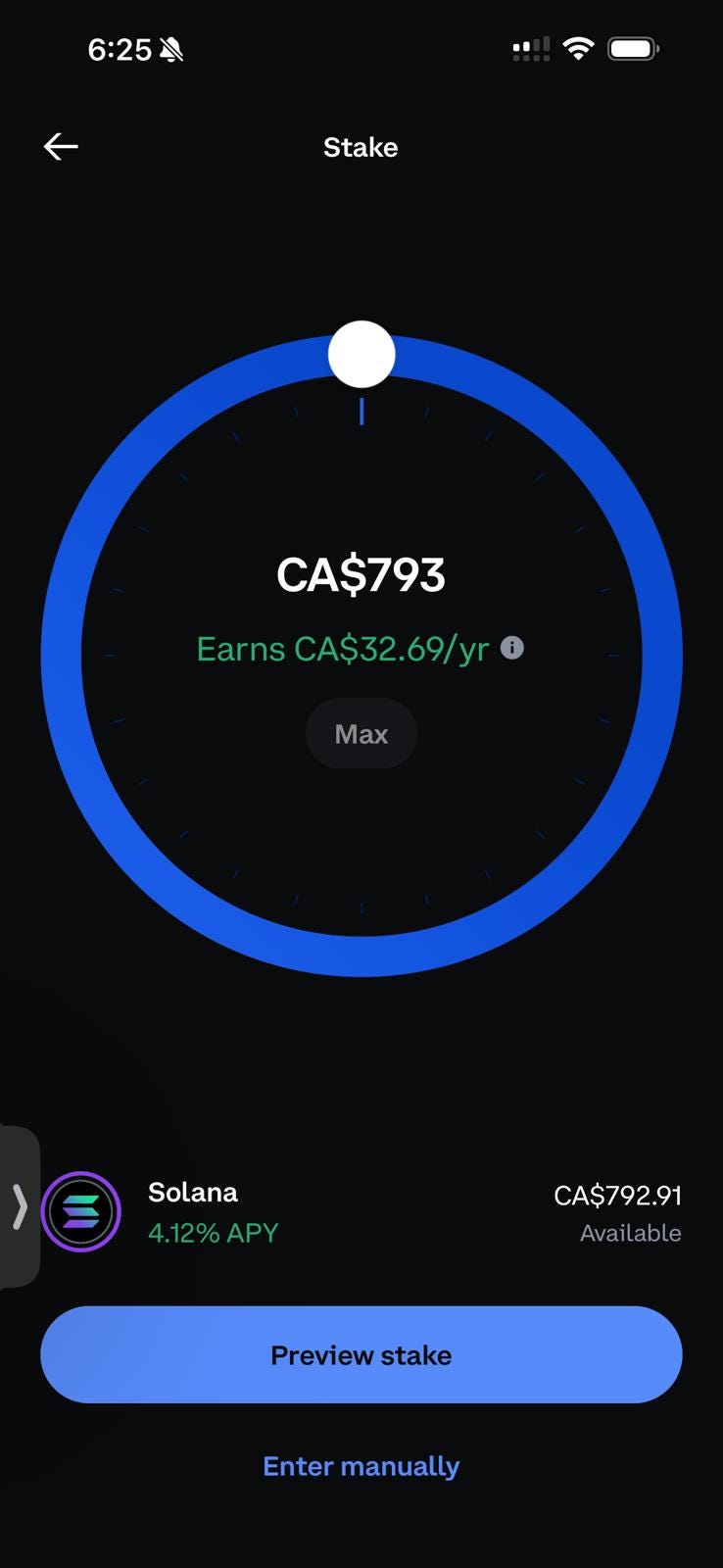
But as smooth as it felt, I couldn’t ignore what was happening under the hood. I wasn’t actually interacting with Solana. Coinbase was. My SOL was pooled with other users’ funds, and Coinbase delegated it to validators on my behalf.
Even the unstaking timeline made that clear. While Solana itself operates on epoch-based timing, Coinbase mentions unstaking can take anywhere from 2 to 30 days. That range exists because they manage liquidity internally. I am dependent on their operational decisions.
The yield was slightly lower than native staking as well at 4.2%. Coinbase takes a margin. It’s not dramatic, but it exists.
The trade-off was clear: maximum simplicity in exchange for custody risk and slightly reduced yield.
Staking On-Chain Through Backpack wallet: Participation
Moving SOL into Backpack felt different immediately. I had to send the funds to my own wallet, verify the address, and then choose how to stake.
For the first time, I saw the validator list. Names I recognized from the ecosystem appeared next to commission percentages and total delegated SOL. Some charged 0%. Others charged 7%. Some had millions of SOL staked. Others were smaller operators.
I had to think.
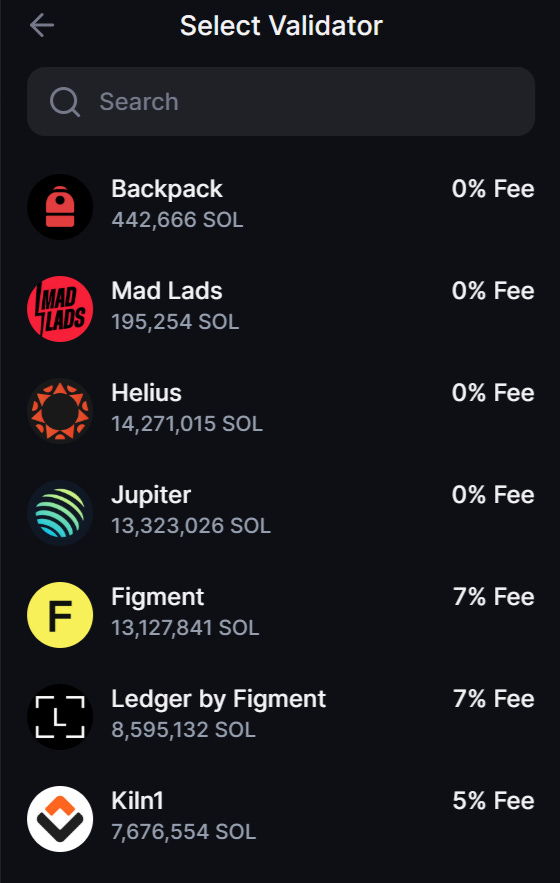
When I delegated natively, I signed a transaction that created a stake account and linked it to a validator. That signature was recorded on-chain. My wallet executed it directly with the network.
This wasn’t a feature inside a company dashboard. It was an interaction with the protocol itself.
Rewards would accrue automatically each epoch, and if I wanted to unstake, I would deactivate the stake account and wait for the next epoch boundary. The rules were transparent and protocol-driven.
That moment made something click. On Coinbase, I felt like a customer. On-chain, I felt like a participant.
Liquid Staking vs Native Staking: A Fork I Had to Consider
While staking through Backpack, I was prompted to convert SOL into a liquid staking token (bpSOL). That introduced another layer I hadn’t fully appreciated before.
Liquid staking would have allowed me to keep my capital flexible. Instead of locking SOL in a stake account, I could receive a token that represented staked SOL and continued earning yield. That token could be traded or used in DeFi.
It was capital efficient. It was modern. It was powerful. Specially for traders.
But it also introduced smart contract risk, potential depeg risk, and additional complexity.
I chose native staking as a long term holder at 6.39% APY. Not because liquid staking is wrong, but because I wanted clarity. I wanted to understand the base layer before stacking strategies on top.
The Yield Difference Wasn’t the Real Story
Going into this experiment, I thought yield might be the deciding factor.
In reality, the difference is small. Validator commission is a percentage of rewards, not of principal. A 7% commission on a 7% network yield translates to roughly 0.49% difference. It’s meaningful at scale, but not life-changing for a modest allocation.
The more meaningful difference was structural.
With Coinbase, I accepted counterparty risk and gave up validator choice.
With native staking, I accepted self-custody responsibility and validator selection risk.
Both have trade-offs. Neither is inherently superior.
What Changed for Me
The biggest shift wasn’t financial. It was psychological.
When I staked on Coinbase, I was using a service.
When I staked on-chain, I was interacting with infrastructure.
That distinction matters.
Staking on-chain forced me to understand validator economics, commission sustainability, and network decentralization. It made me think about why some validators charge 0% and others 7%, and why large operators still attract significant delegation despite higher fees.
It transformed staking from a passive yield feature into a governance-adjacent decision.
Final Reflection
If someone values simplicity and familiarity, staking through a centralized exchange works perfectly well. It reduces friction and lowers cognitive load.
If someone values self-custody and direct protocol interaction, staking on-chain offers a deeper connection to the network.
The yield difference is small. The philosophical difference is not.
And now that I’ve done both, I understand that staking is not just about earning more SOL. It’s about choosing how you want to participate in the system.
Not financial advice.
Staking comes with associated risks. Understand before proceeding.